AI-Powered Trading Assistants: How GPT + Real-Time Data Is Transforming Modern Trading
Discover how AI trading assistants use GPT, machine learning, and real-time data to improve market analysis, execution, and modern trading decisions
Table of Contents
The financial sector is changing thanks to Artificial Intelligence, and AI trading tools help traders analyse news, track sentiment, manage real-time information, and automate trading in seconds. The worldwide market for AI in finance will see even greater growth, with institutions investing heavily in machine learning and real-time analytics, according to Bloomberg Intelligence, which projects the market to be larger than $130 billion by 2032.
However, amid the noise and excitement of AI-driven stock trading and automated bots, savvy traders are finding that discipline, context, and risk management remain crucial. Rather than taking the place of human judgment, AI trading assistants are evolving into smarter support systems, enabling traders to respond more quickly, cut through the noise, and make more systematic trading decisions, particularly in today’s volatile markets.
What Is AI Trading?
Artificial intelligence is changing how traders analyse markets, manage risk, and execute trades. Instead of relying only on manual chart analysis, modern AI trading software can process massive amounts of financial data within seconds.
Today, AI trading systems are commonly used in:
- stock trading
- forex trading
- crypto markets
- high-frequency trading
- institutional trading desks
However, many traders confuse traditional trading bots with true AI-powered trading assistants.
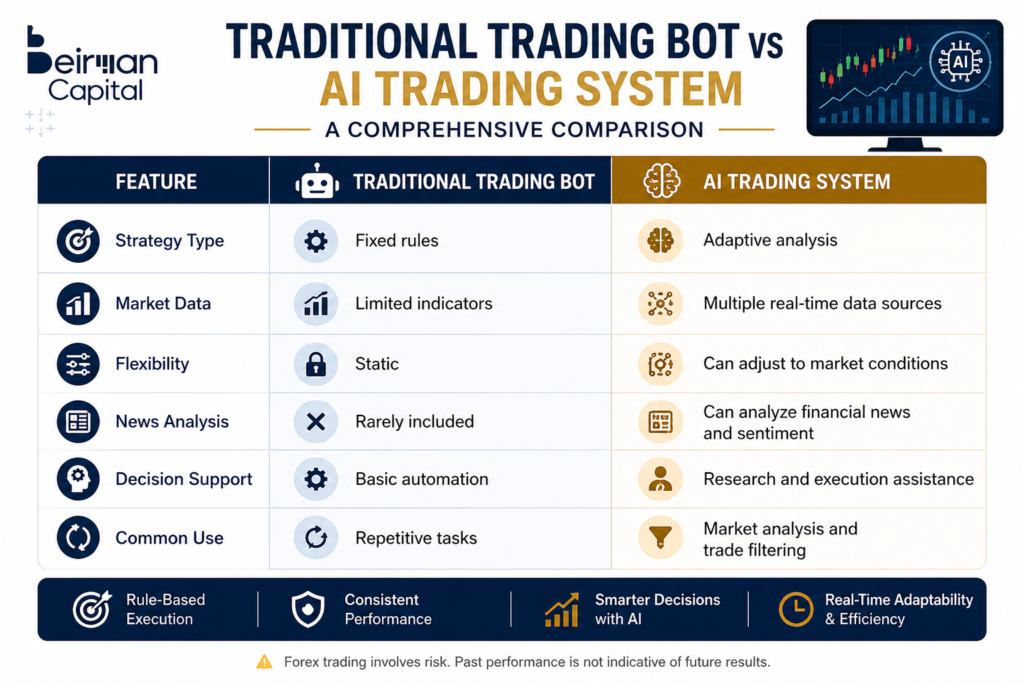
This is why AI stock trading and AI trading platforms are gaining attention across financial markets.
Modern trading AI can help traders:
- monitor volatility
- scan multiple assets
- track market sentiment
- summarize financial news
- test trading ideas
- automate repetitive tasks
But despite the growing hype around AI trading applications, most experienced traders still use AI as a support tool rather than fully autonomous decision-making software.
The real advantage of AI and trading technology is not perfect prediction. It is the ability to process information faster and help traders make more structured decisions in fast-moving markets.
What Does GPT Stand For and Why Are Traders Using It?
GPT refers to Generative Pre-Trained Transformer, a category of powerful language models employed in AI-based trading systems, such as ChatGPT and Claude AI. These tools have become a valuable asset for traders seeking to gain a competitive edge in their trading endeavours.
The following are common applications of AI in stock trading today:
- summarising financial news
- generating trading ideas
- analysing market sentiment
- coding trading strategies
- building trading journals
- Making market data simple
One of the reasons why AI stock trading and AI day trading tools are gaining popularity in the financial market is the increasing use of AI and trading technology. The growing popularity of AI stock trading and AI day trading tools in the financial market is partly due to the widespread adoption of AI and trading technology.
But GPT is unable to foretell the market with certainty. While many experienced traders utilise trading AI as a supplementary tool alongside actual information, technological analysis, and disciplined risk management, they rarely depend entirely on it.
Why Real-Time Data Matters in AI Trading
AI trading software is believed to be able to forecast the markets automatically by many traders. The best trading AI can actually be unreliable when it comes to data delays.
In times of big events such as inflation reports, interest rates or earnings releases, the financial markets will react within seconds. If the information provided to an AI trading platform is inaccurate, it can make trades that are made too late on the opportunity.
This is the reason why professional companies are heavily dependent on real-time data processing.
AI trading systems constantly monitor:
- live price movements
- market volatility
- economic news
- trading volume
- sentiment changes
If you’re investing for the long haul, that data isn’t necessarily going to be important. However, real-time data plays a crucial role in AI day trading and short-term trading, affecting the quality of execution and risk management in these strategies.
The true value of AI is more about the process than just automation. The capacity to handle the market information sufficiently fast to enable a quicker and more structured decision-making process.
Can GPT or Claude AI Create Profitable Trading Strategies?
As AI trading software has emerged on the scene, there is a growing number of traders testing out tools such as ChatGPT and Claude AI
To create trading ideas, indicators, and automate research.
Of course, a question always comes to mind:
Are there profitable trading strategies that can be developed using AI?
The answer is both Yes and No.
Large language models can assist traders in a variety of ways, such as:
- generate strategy ideas
- code trading indicators
- summarize market data
- analyse historical patterns
- backtest concepts faster
- simplify technical research
That’s why AI trading stocks and AI day trading tools are becoming more and more popular.
Many traders, however, approach this new trading method with false expectations of AI’s capabilities.
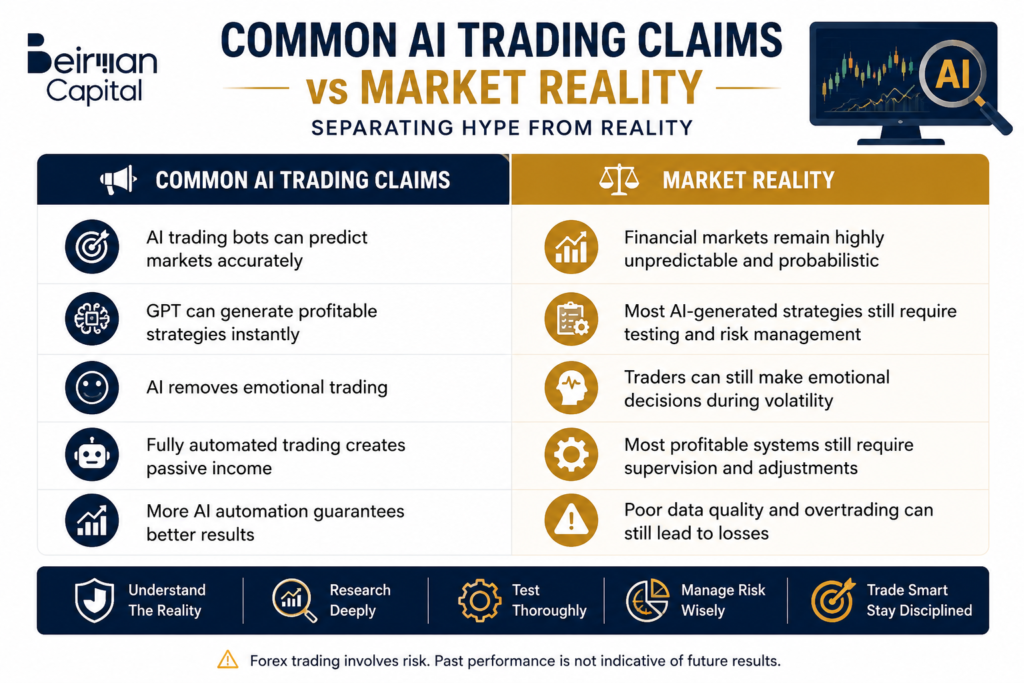
In reality, AI works best as a support system rather than a fully autonomous trading machine. Most professional traders still rely heavily on:
- risk management
- position sizing
- market context
- execution discipline
- real-time data analysis
The biggest advantage of trading AI is not guaranteed prediction. It is the ability to process information faster and support more structured decision-making in rapidly changing financial markets.
Best Use Cases for AI in Trading Today
Even with all the excitement that surrounds AI trading bots, not many traders are leveraging AI to automate their trading portfolios entirely. Rather, AI is evolving as a tangible aid to trade, enabling traders to sift through data more quickly and to make more coherent decisions.
AI trading software is prevalent in today’s landscape for the following purposes:
- Multi-marketing scanning
- summarising financial news
- tracking market sentiment
- monitoring volatility
- backtesting trading ideas
- building trading journals
- Automation of alerts and repetitive tasks
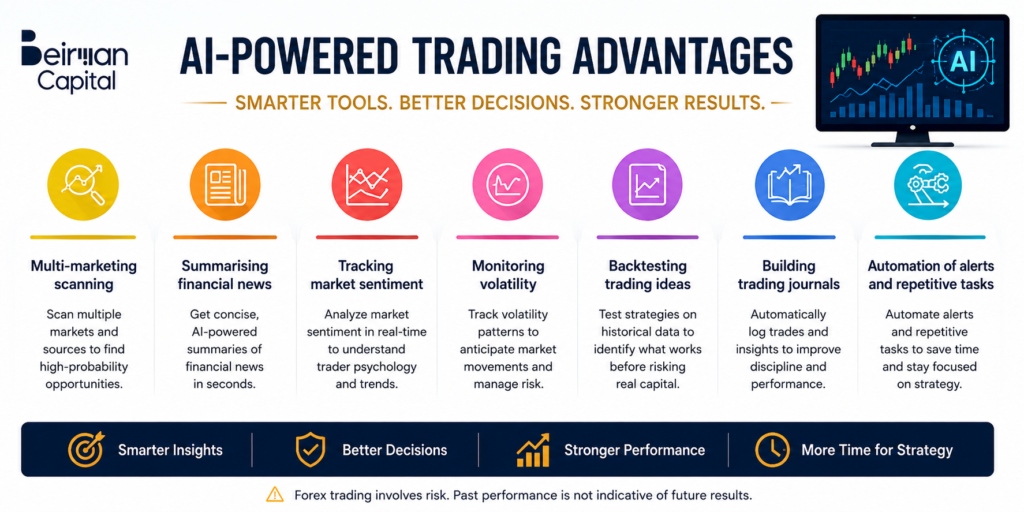
This is one of the major reasons why AI stock trading and AI day trading tools are gaining popularity in the financial world.
For instance, an AI trading assistant can scan hundreds of stocks, glean data on unusual market activity, summarise earnings reports and focus on possible setups in seconds. It’ll take a lot longer to do this work by hand.
A lot of experienced traders, however, don’t completely rely on automation. The financial markets are constantly evolving, and what works well in one situation may not work well in another.
The best way to utilise AI and trading technology today is not to fully replace traders. It’s assisting them to sift through information, cut through the noise and make better decisions in a high-speed marketplace.
What Most AI Trading Bot Marketing Gets Wrong
There are several AI trading platforms on the market that are touted as “fully automated” systems that can make steady profits for the investor with minimal work. However, the real market conditions are quite unpredictable.
One of the biggest pitfalls in trading stocks with AI is assuming that it is a risk-free approach. In fact, even the most advanced trading AI can make mistakes during volatile trading periods, trend reversals, and bad periods of trading.
Many traders who experimented with AI trading bots determined that discipline and risk control are more significant than the actual trading automation:
The most successful traders often think of AI trading software as a tool to assist them, not a profit-maker. That is why the firms such as Beirman Capital highlight modern trading technology, long-term risk management and structured analysis and discipline.
How Professional Traders Are Actually Using AI
No, AI trading software isn’t a means to quick wealth for professional traders. Rather, the majority of companies rely on artificial intelligence to speed up, enhance and analyse markets.
Nowadays, trading AI is widely employed to:
- Keep track of several markets at once
- Interpret a considerable volume of financial information
- Detect unusual volatility
- Monitor and track market sentiment in real-time
- Improve execution timing
- Cut down on the time spent in manual research
Many large institutions and hedge funds are also leveraging AI to analyze real-time data and make quick decisions during significant economic shifts and in response to real-time data.
But, even for the more advanced traders, human oversight remains an important element. While AI can analyse large volumes of data in real-time, it can not capture market sentiment, unforeseen global events, or fluctuating trading conditions.
Key Risks of Using AI in Trading
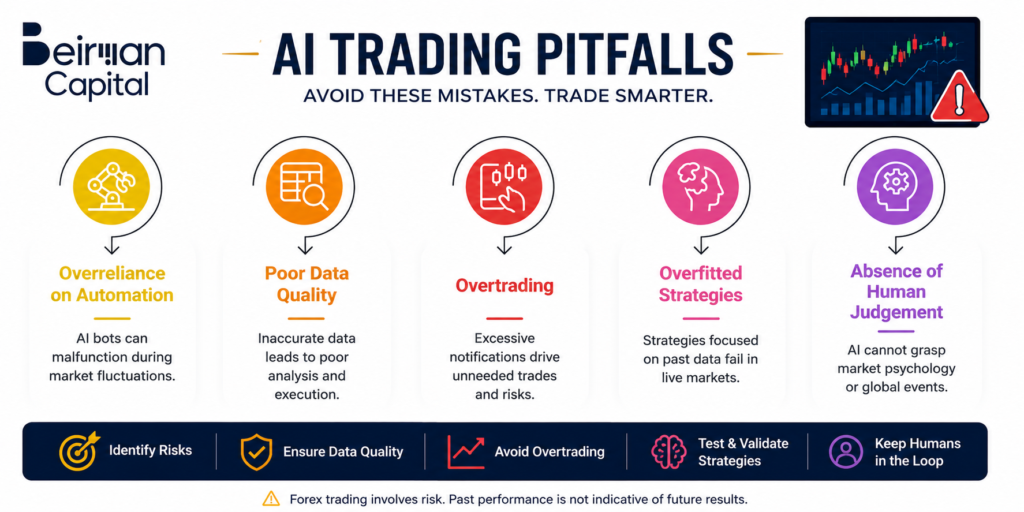
AI Trading Platforms are increasingly sophisticated, but they have their fair share of pitfalls for novices.
1. Overreliance on Automation
A lot of traders believe that AI trading bots are able to adjust seamlessly to any market conditions. In fact, financial markets are constantly evolving, and automated trading systems can malfunction during unforeseen market fluctuations.
2. Poor Data Quality
Real-time data is a critical component of AI trading software. Having delayed or inaccurate market data can result in poor analysis and execution of trades.
3. Overtrading
Excessive notifications and automated signals can drive traders to make unneeded trades, worsening risks and emotional choice-making.
4. Overfitted Strategies
In live markets, some strategies developed with AI produce good returns but don’t work in practice due to an excessive focus on past data.
5. Absence of Human Judgement
While trading AI can handle data efficiently, it cannot grasp all the nuances of market psychology, global events or sudden shifts in sentiment.
This is why the majority of seasoned traders opt for using AI as an aid and not automation. In today’s trading environment, the principles of risk management and disciplined execution are still vital.
Conclusion
While AI is a tool that is rapidly reshaping the financial landscape, trading success relies far more heavily on other factors than mere automation. AI trading software can assist traders in handling real-time data, analysing the markets at a quicker pace, and making better decisions, but it does not remove the uncertainty or ensure profits.
Today, the best traders are leveraging AI tools but are not solely dependent on automated trading bots. Ultimately, discipline, structured analysis, risk management, and the ability to adjust strategies in response to market conditions remain key when it comes to real success in the field of AI stock trading.
With the ongoing advancement of AI and trading technology, traders who leverage a blend of cutting-edge tools and effective market knowledge will likely find themselves in a robust situation. This is also why companies that focus on trading, such as Beirman Capital, are emphasising disciplined trading frameworks, market education, and risk-focused decision making in addition to emerging AI-powered trading technologies.
FAQ
AI trading assistants are software applications equipped with AI algorithms that can analyse market trends, patterns, and data to provide real-time trading insights and support.
By leveraging GPT technology, traders can quickly summarise financial news, analyse sentiment, retrieve strategy ideas, and process complex market information, making better and faster decisions.
During volatile markets, real-time data feeds allow AI trading systems to respond more quickly to market shifts, resulting in more accurate analysis and execution of trades.
The machine learning algorithms used in the trading algorithms help them in analysing the past market trends, detecting patterns and optimising the trading models with a huge volume of financial data.
While AI trading systems offer benefits, they can still result in losses during periods of market shifts, where data is not quality-controlled, or when there is unexpected volatility. For this reason, human oversight and risk management remain crucial.
Get Complete Forex Trading Assistance