
Liquidity Sweep in Trading: Strategy, Examples, Charts and How Smart Money Uses Liquidity
Learn how liquidity sweeps really work in trading. See real examples, charts, and smart money strategies used to target buy-side and sell-side liquidity.
Table of Contents
Financial markets fluctuate due to the execution of orders, and behind most significant price fluctuations, there is one key element: liquidity. Big institutions are always seeking places where they can make big orders in global markets like the forex, where the daily trading volume is over $7.5 trillion as per the Bank of International Settlements. It is at this point that the idea of a liquidity sweep comes in.
A liquidity sweep is a situation where the price momentarily goes above or below important highs or lows to cause groups of stop losses before turning back. These regions are referred to as buy-side liquidity and sell-side liquidity and tend to cluster around support, resistance or equal highs and lows where a large number of retail traders have their stop orders.
Learning about the liquidity sweeps will enable the traders to understand the institutional behaviour, smart money, and liquidity pools, which will enable them to interpret market movements more clearly instead of responding emotionally to sudden price spikes.
Liquidity in Trading and How Liquidity Sweeps Work
Liquidity sweeps are common at major technical levels where traders have stop losses. These are the areas that are typically liquidity pools and thus are often targeted when the market is more active.
A bullish liquidity sweep is where the price temporarily falls below a support level or equal lows to initiate sell-side liquidity and then returns upwards. When such stop losses are triggered, the market becomes liquid to make bigger buy orders.
A bearish liquidity sweep moves in the reverse direction. Price will temporarily rise beyond a resistance level or equal highs to initiate buy-side liquidity, and then the market can turn back down.
These tendencies are common in very liquid markets like forex, particularly when the trading is active, the number of participants is high, and the liquidity is high.
Why Smart Money Sweeps Liquidity
Liquidity sweeps are directly related to the smart money concept, which is concerned with the operation of large institutional traders in financial markets.
Institutions like banks, hedge funds and liquidity providers do not trade with small order sizes like retail traders. Due to this, they are not able to just enter positions at market price without making a large price movement. The large trades need adequate trading liquidity; that is, there must be enough counter orders in the market.
This is the reason why institutional traders tend to attack liquidity pools, where groups of orders already exist. These pools are, in most instances, created by retail traders who place stop losses in areas that are predictable.
Typical places of liquidity accumulation are:
- above recent highs generating buy-side liquidity.
- under recent lows, developing sell-side liquidity.
- at support and resistance levels.
- close equal highs and equal lows.
Stop loss orders are activated when the price hits these levels, and they are converted into market orders. This provides the liquidity required by institutions to conduct large positions effectively.
As an illustration, in the forex market, it is typical to observe prices temporarily surging above a past high to absorb buy-side liquidity and then turn downwards. This is referred to as a liquidity sweep and is common when there is high-volume trading, like in London or New York.
This institutional behaviour is a significant aspect of liquidity trading strategies because it assists traders in understanding why markets occasionally go beyond important levels and then turn around.
Liquidity Sweep Example in Real Market Conditions
Liquidity sweeps usually happen at major technical levels where traders have their stop losses. These are the areas that tend to have liquidity pools and, therefore, are often targeted during times of heightened market activity.
A bullish liquidity sweep is a short-term movement of the price below a support level or equal lows to initiate sell-side liquidity and then return to the upside. When those stop losses are triggered, the market receives the liquidity required to make bigger buy orders.
A bearish liquidity sweep is the reverse. Price then shifts over a resistance level or equal highs to cause buy-side liquidity, and then the market can turn back down.
These trends are common in very liquid markets like forex, particularly when the trading sessions are active, and more people are involved, and the liquidity level is high.
Where Liquidity Forms in Financial Markets
Financial market liquidity does not occur by chance. Rather, it is more likely to accumulate at certain technical levels at which traders usually order. These regions tend to turn into pools of liquidity, as many stop losses and open orders are concentrated in one place.
Equal highs and equal lows are one of the most prevalent locations where liquidity is formed. When the market constantly hits the same price, a lot of traders anticipate the level to be maintained. Consequently, they locate their stop losses slightly above those levels, forming clusters of buy-side liquidity or sell-side liquidity.
The liquidity also has a tendency to form around the support and resistance levels and the highs and lows of the trading ranges. These regions are highly concentrated with orders since traders utilize them to establish the entry points and risk levels.
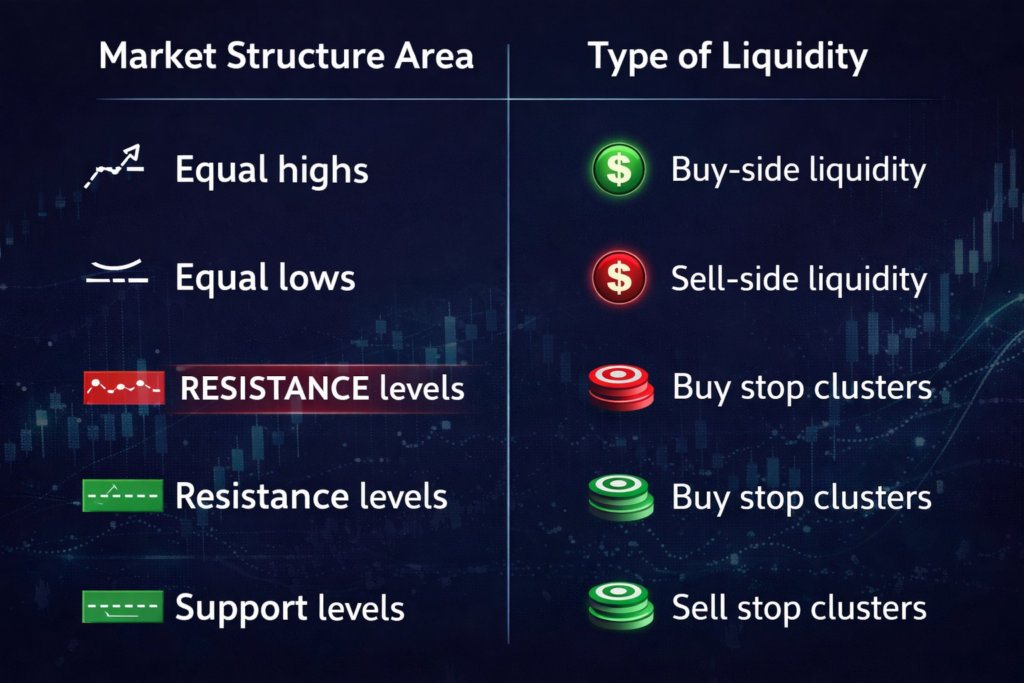
Understanding where liquidity forms helps traders identify liquidity zones on the chart, which are the areas most likely to be targeted during a liquidity sweep. Recognising these zones is an important step in analysing how price interacts with liquidity pools in forex and other financial markets.
Liquidity Sweep Trading Strategy
Liquidity sweep trading strategy involves the identification of liquidity likely to be taken in areas and waiting to be confirmed before a trade is made.
The initial one is to identify liquidity areas, which tend to be found at equal highs, equal lows, and significant support or resistance levels. Such regions are likely to have groups of stop losses that form buy-side or sell-side liquidity.
After identifying a liquidity zone, traders wait until the price passes the zone and initiates the liquidity. This is the liquidity sweep movement, in which the stop loss orders are triggered.
Once the sweep has taken place, traders normally seek confirmation that the market can turn around. This may be a rejection candle or a swift reversal within the last range.
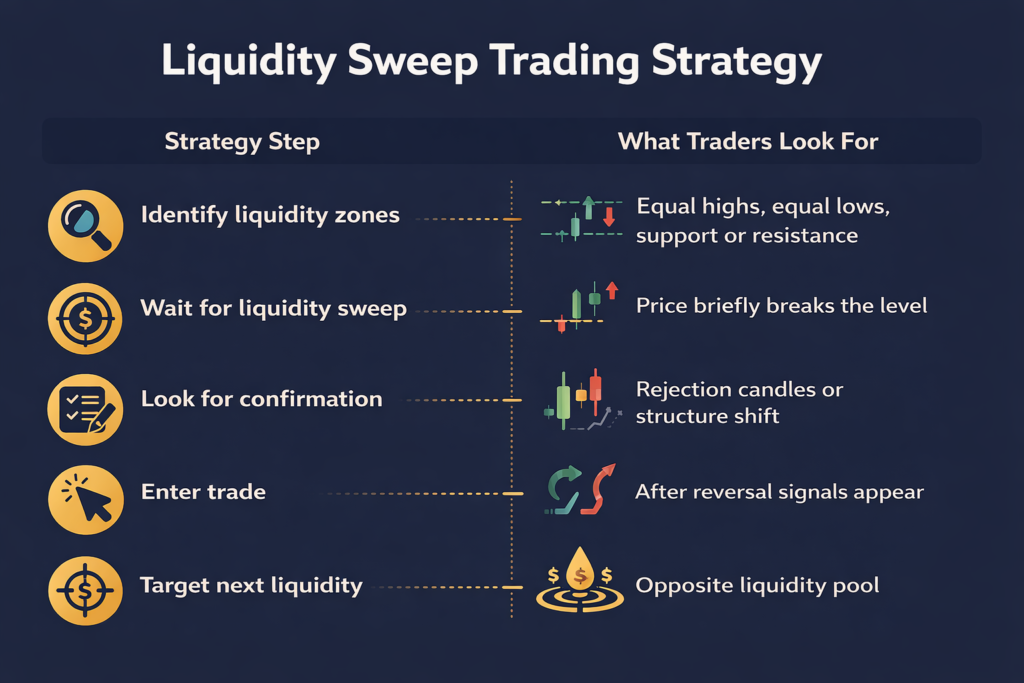
Many traders place stop losses slightly beyond the sweep level and aim for the next area where liquidity may exist.
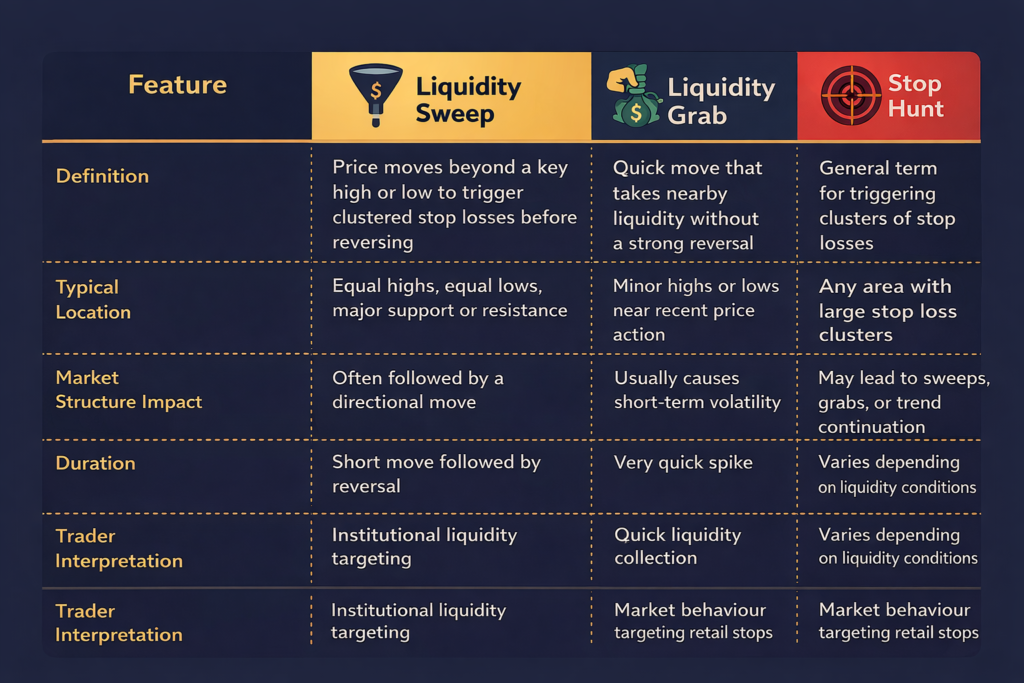
Liquidity Sweep vs Liquidity Grab vs Stop Hunt
These terms are often used interchangeably in trading, but they describe slightly different types of liquidity-driven market behaviour.
Common Mistakes Traders Make When Trading Liquidity Sweeps
Despite the popularity of the liquidity sweeps in the trading strategy, a lot of traders misunderstand the way it takes place in the live markets.
A typical error is to trade too early, hoping that the market will turn around and then liquidity will be withdrawn. In most instances, liquidity is swept in the market and then flows in the desired direction.
The other common problem is to put stop losses in the apparent liquidity areas, like directly over the resistance or under the support areas. These regions are usually natural targets of liquidity sweeps.
Higher timeframe liquidity is also not given much attention by traders, as they only pay attention to short-term price movements.
Common mistakes include:
- arriving before the sweep.
- installing stops in foreseeable areas.
- disregarding longer-term liquidity.
- supposing that each breakout is an indication of a new trend.
Conclusion
Liquidity sweeps are a significant concept in contemporary trading as it shows how the price reacts to liquidity pools, clusters of stop losses and institutional order flow. Rather than perceiving sudden price surges as anomalous market behaviour, traders who are aware of liquidity sweeps can interpret such behaviour as the market accessing buy-side or sell-side liquidity.
Traders can understand market structure and prevent typical trading errors by understanding the location of liquidity and the way sweeps take place around important levels.
Traders at Beirman Capital are taught how market behaviour that is driven by liquidity fits into a larger institutional trading model. The knowledge of the liquidity zones, market structure and smart money behaviour can guide traders to be more disciplined and clear in their approach to the market.
Trading liquidity is characterised by clustered stop losses, equal highs or lows, trendline contacts and high volume zones where institutions are likely to be targeting orders to be executed.
The most appropriate trading plan is based on your style, though price action, risk management, and consistency are important. Trend following, breakout trading, and SMC are strategies that are effective for beginners.
The most effective SMC plan is to determine the market structure, order blocks, liquidity zones, and wait to confirm entries following liquidity sweeps in trending or reversal situations.
Injunction liquidity is seen when there is a sharp spike, news events, or a stop hunt where the price is able to take liquidity above the highs or below the lows and then turn sharply.
Liquidity of a firm is the capacity of the firm to fulfill the short term obligations. It is influenced by cash flow, current assets, liabilities, access to credit and efficiency of operations.
A deposit sweep program is a program that automatically transfers surplus funds in a bank account to interest-earning accounts or investments to maximise returns without compromising on liquidity and accessibility.
Sweep in account automatically transfers extra funds into investments with higher interest rates or transfers funds back on demand, maintaining the best balance between liquidity and returns.
A deposit sweep program is a program that transfers idle cash into interest-bearing accounts or investment vehicles automatically, which helps to maximise returns and keep the funds available to make transactions or withdrawals.
Get Complete Forex Trading Assistance