
Doji Candle Explained: Meaning, Types, and Proven Trading Strategies
Struggling with doji candle signals? Learn what a doji candle means, how to identify its types, and trade it effectively using proven strategies and confirmation.
Table of Contents
Most traders don’t lose because they lack signals. They lose because they misinterpret them.
The doji candle is one of the most common yet misunderstood patterns on any chart. Indecision candles appear frequently in high-volume markets like stocks and forex, but only a small number of them lead to actual reversals. This is where many traders get trapped.
A doji forms when the opening and closing prices are nearly the same, signalling a pause in momentum. It is not a buy or sell signal, but a decision point in the market.
In this guide, you’ll learn how to read doji candlesticks correctly and use them to identify high-probability trading setups instead of false signals.
What Does a Doji Candle Indicate in Stock Trading and Technical Analysis?
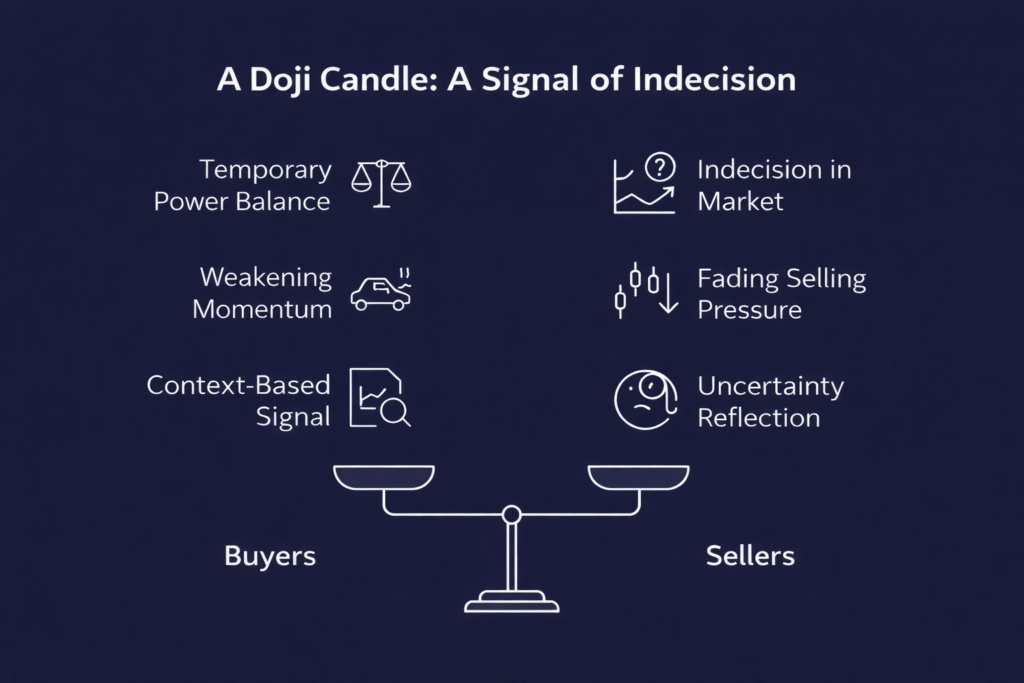
Doji used candles are a clear indication of one thing: market indecisiveness.
It is developed when both buyers and sellers allow the prices to swing in both directions of the market, with neither party taking control at the end of the day. This forms a candle having an extremely tiny body with the wicks frequently extending, displaying a momentary equilibrium of strength.
This is important when it comes to stock trading and technical analysis since the market tends not to turn just in any fashion. At the outset, they decelerate. A doji may tend to appear at that specific point in time when the momentum is/is becoming weaker.
Yet here most traders overlook this much:
Direction is not indicated by a doji. It reflects uncertainty.
- Once an uptrend is experienced, followed by another uptrend, then this can be an indication of buyer fatigue.
- Once the downward trended above it can be seen that selling pressure wanes.
- In sideways markets, it is commonly noise, not opportunity.
Professional traders do not consider a doji a trigger but a signal, dependent on the situation. It gains its meaning when it is accompanied by trend, key levels, and confirmation of the following candle.
Is a Doji Candle Bullish or Bearish — How Should You Interpret It?
A doji candle is not in itself bullish or bearish; it is neutral. Its definition will be wholly dependent on the market set-up.
A doji may indicate that the buying momentum is decelerating following an uptrend, and potentially the market will reverse towards the downward side. It can be used to signify sellers losing control, thus making a bullish trend more likely following a downward trend.
In cross-markets, however, the dojis tend to be of little value, and the false signals are generated.
It is all about confirmation. Direction is characterised by a powerful candle following the doji.
A doji is a break in the market and not a choice. It advises that you wait, watch and trade when it goes.
What Are the Different Types of Doji Candles and How to Identify Them on a Chart?
Not all doji candles mean the same thing. The type of doji gives deeper insight into market behaviour and trader sentiment.
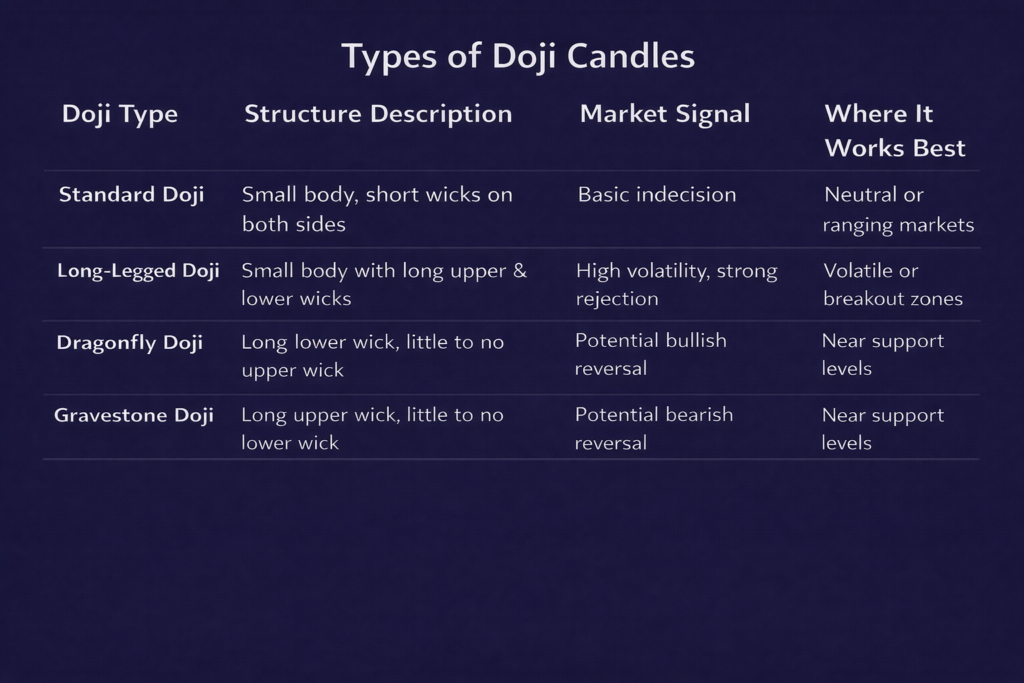
Professional traders don’t focus on the name of the doji alone. They analyse the structure and location of the candle within the market.
A dragonfly doji at a strong support level or a gravestone doji near resistance carries far more significance than a random doji formed in the middle of a range.
In high-liquidity markets like forex and major stocks, many dojis appear during normal price movement. Filtering them based on context, trend, and key levels is what separates high-probability setups from noise.
How to Identify Doji Candles on a Chart
It is easy to find a doji, yet it is the failure to find useful doji which most traders have brought about.
Start with the basics:
- The open and close prices are practically the same, forming a very thin or invisible body.
- Wicks (shadows) display the distance to which the price had gone and then bounced back.
Then give hope to what matters:
- Look at the trend preceding the doji → Uptrend or downtrend provides the context.
- Consider the important levels → Supporters and resistance enhance accuracy.
- Notice the length of the wick → lengthened wicks = high rejection.
- Wait until the next candle emerges→ Confirmation is direction.
Veteran traders do not arbitrarily see a doji; they do not see them all. A doji at a significant level and confirmation is an indicator. An accidental doji during the wilderness is normally a noisy thing.
What Do Long-Legged and Dragonfly Doji Candles Signal in Real Market Conditions?
Not all dojis carry the same weight. Long-legged and dragonfly doji reveal deeper market behaviour like volatility, rejection, and liquidity shifts.
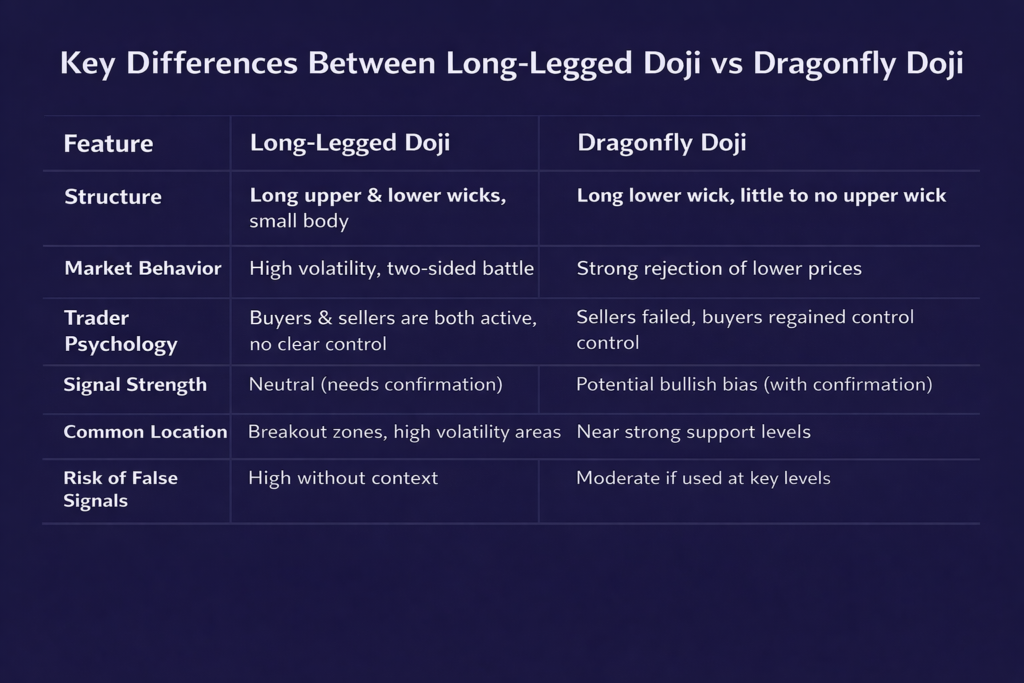
- Long-Legged Doji → Indicates that the market is volatile and about to make a powerful movement, although it is also uncertain.
- Dragonfly Doji → goes to show that the price was driven down and repelled hard, which indicates a potential bullish reversal pattern.
In buy-sell trading, the professionals dwell on the range and location:
- Volatility expansion tends to be preceded by a long-legged doji with a large range.
- Support with a volume of dragonfly doji usually indicates that there is strength of buyers in the market.
The two patterns are readily distorted into false signals in the absence of these factors.
How to Use Doji Candle Patterns in Day Trading and Swing Trading Strategies
Instead of treating strategies separately, it’s more effective to understand how a doji candle behaves in different market conditions. Most doji candle trading setups fall into two categories: reversal and breakout.
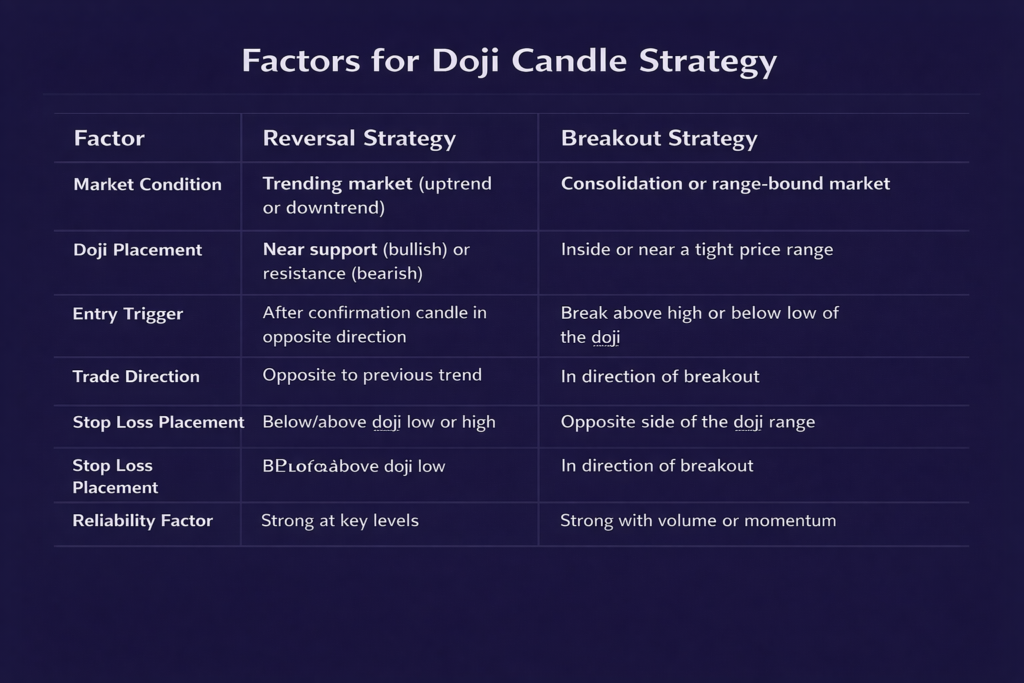
Instead of treating strategies separately, it’s more effective to understand how a doji candle behaves in different market conditions. Most doji candle trading setups fall into two categories: reversal and breakout.In real market conditions, doji candle strategies work best when combined with clear market structure, strong support and resistance, and volume confirmation. Without these factors, even high-quality setups can fail.
How to Apply This in Real Trading
- Reversal setups are to be taken in a trending market. A doji approaching a significant level may be an indication of a declining momentum.
- In a lateral or converging market, change to breakout logic. Doji can also come up preceding expansionary motions.
Many traders understand these strategies in theory but struggle to apply them in live markets where timing and confirmation matter.
At Beriman Capital, we help traders identify high-probability setups using real-time market insights, structured strategies, and expert-backed trade signals, so you’re not relying on patterns alone.
Day Trading vs Swing Trading Perspective
Day trading:
Apply both of the strategies to lower timeframes, but use a quick confirmation and strict stop losses.
Swing trading:
Pay more attention to reversal positions at top strengths. The moves of higher timeframe dojis are more likely to be reliable.
Experienced traders don’t trade every doji they see. They wait for the right conditions, because in most cases, the absence of a trade is better than a low-quality setup.
Key Takeaway
Doji is not a strategy on its own. It is powerful as it is up to you to choose what environment you are trading in and then use the appropriate approach.
What Is the Best Way to Trade a Doji Candle?
A doji candle becomes useful only when you know exactly how to execute the trade. Most mistakes happen not in identifying the pattern, but in poor entry and risk management.
Trade Execution Framework for Doji Candle
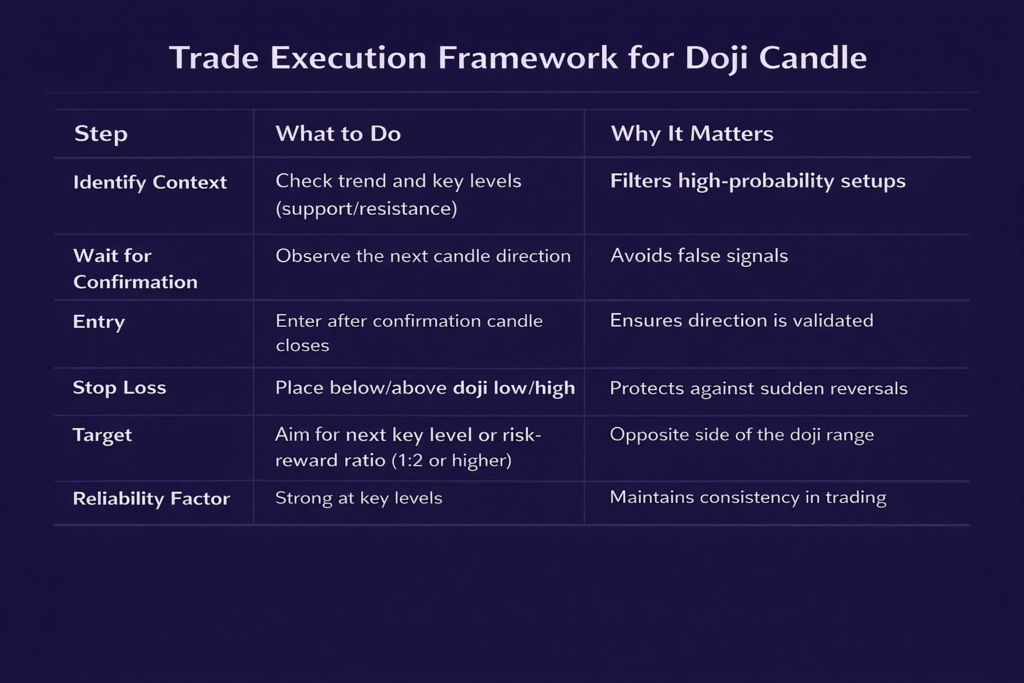
Entry Rules
- Do not enter immediately after a doji forms
- Wait for a strong confirmation candle
- Prefer setups near important price levels
Stop Loss Placement
- For buy trades → below the low of the doji
- For sell trades → above the high of the doji
This method works because a valid setup should not break the structure of the doji.
Confirmation Is Critical
A doji without confirmation is one of the most common reasons for failed trades.
Traders often confirm using:
- Strong bullish or bearish candle after the doji
- Break of structure (higher high or lower low)
- Confluence with support and resistance
Practical Insight
In real market conditions, not every doji is worth trading. High-quality setups usually form:
- At strong support or resistance
- After extended trends
- With clear rejection (long wicks)
Summary
- Entry comes after confirmation, not before
- Stop loss should be based on the doji structure
- Context and discipline are more important than the pattern itself
A structured approach turns the doji candle from a confusing signal into a practical trading tool.

How Reliable Is a Doji Candle and What Are Its Limitations?
In active markets, doji candles appear frequently, especially on lower timeframes, where a large number of these signals fail to produce meaningful price movement.
A doji candle is not a very effective one. It comes up repeatedly on charts, particularly in relatively short periods of time, and lots of these signals do not result in a significant price move. That is why one should not refer to the doji only, and it leads to false trades in most of the cases.
It becomes reliable when employed in the right context. The doji becomes significant when it is made close to the strong support or resistance, when there is a definite trend and a subsequent confirmation candle.
Limitations of the Doji Candle
- Occurs with high frequency, particularly in intraday charts.
- There is no definite bullish or bearish way to go.
- Can create unverified signals.
- Demands a powerful background, such as a trend and key levels.
- Inconsistent in less liquid or low-volume markets.
Simply put, a doji candle is an indication to watch the market not to trade at the moment.
This is why experienced traders rely on context rather than the pattern itself, as the accuracy of a doji candle improves significantly when combined with trend, key levels, and confirmation.
Conclusion
The doji candle is also easy to identify and hard to use effectively. It does not show what is happening in the market, but raises an indication of a state of stagnation when the tide is turning.
It also depends on context, and not the pattern itself, to realise its true value. A doji candlestick can be used in conjunction with trend, key levels, and confirmation to recognise high-probability layouts. In its absence, it is likely to cause false signals and unwarranted trades.
The majority of traders fail to do so too fast. Seasoned traders wait till it becomes clear.
To use proven doji candle strategies when seeking a position in the real market rather than trying to draw a line, Beriman Capital offers systematised trade and signal coverage on the basis of experienced traders, in addition to a disciplined approach to trade, so that you trade with confidence.
FAQ
Doji is a neutral candle, but it represents indecision. After being confirmed by the subsequent candle and its placement in the whole trend, it becomes either bullish or bearish.
Doji candle rule is that the traders must wait to be sure they are trading before they enter in a trade, as the pattern on its own does not show a definite direction, but a sign of uncertainty.
Once a doji candle has occurred, the market will generally move in a direction, though the result will depend on the confirmation, context of the trend and the support or resistance levels around it.
A doji candle may indicate a possible reversal, but only when it follows a good trend and is supported by the next candle and market structure.
Traders trade by confirmation, taking up the subsequent candle, and adding the support, resistance, and trend analysis to trade with greater likelihood.
The primary forms of doji candles are standard doji, long-legged doji, dragonfly doji, and gravestone doji that demonstrate various market behaviours and possible price movements.
Stop loss is normally set below the doji low on the buy trades and above the doji high on sell trades to avoid invalid setups.
Get Complete Forex Trading Assistance