
Top NDF Currencies 2026: Forecast & Trading Guide
Discover the best NDF currencies for 2026, key trends, and expert insights to trade non-deliverable forwards with confidence.
Table of Contents
The non-deliverable forward (NDF) markets are gaining more and more significance as international investors are interested in exposure to the emerging economies with limited currencies. An NDF is a cash-settled forex contract, usually in US dollars, to trade such currencies as USD/CNY, USD/KRW and USD/ TWD, where offshore access is restricted.
By the year 2026, NDF currencies will be more involved in hedging, speculation, and macro trading. As interest rates, capital flows and geopolitical risks change, some emerging market currencies are becoming popular in the forward market.
Here, we discuss the best NDF currencies in 2026, major trends that will define the market and how traders can exploit these opportunities in a strategic manner.
What is a Non-Deliverable Forward (NDF)?
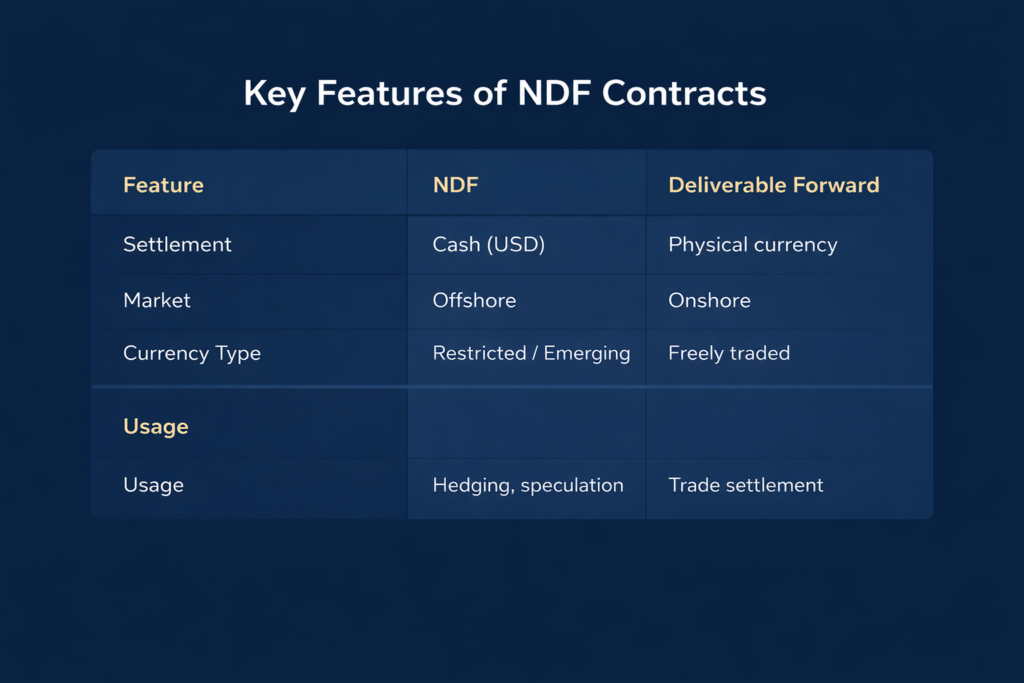
A non-deliverable forward (NDF) is a foreign exchange contract in which the two parties to such a contract contract to pay the difference between a specified forward price and the spot price on the maturity date without physically receiving or giving the underlying currency. Rather, it is settled in a freely convertible currency, usually the US dollar.
NDFs are predominantly applied to currencies that are limited or not fully convertible in the international markets, like USD/CNY, USD/KRW and USD/TWD. These contracts enable the market participants to have exposure or hedge risk in the emerging market currencies without having direct access to onshore markets.
Key Features of NDF Contracts
Example of an NDF Trade
Assume an investor gets into a USD/CNY NDF contract at a forward rate of 7.20. When the spot rate at maturity is 7.30, the difference will be settled in USD, and the investor will gain from the price movement without the exchange of the underlying currency.
This framework renders NDFs an important tool of exposure management to limited currencies when trading in offshore financial markets.

Why NDF Markets Matter in 2026
The non-deliverable forward (NDF) markets are no longer niche. As they move into 2026, they are turning into an essential element of global currency trading, particularly among investors who are focusing on emerging markets.
Increasing Demand for Emerging Market Exposure
A number of economies still have currency restrictions. Due to this fact, institutions use NDF contracts to hedge risk and to get involved in price movements without having to enter into local markets.
Greater Volatility Provides Opportunity
The emerging market currencies are becoming increasingly volatile due to interest rate changes, inflation cycles, and geopolitical uncertainty. This renders NDFs hedging as well as speculative.
NFDA Trading Institutional Growth
Statistics and information cited by the Bank of International Settlements indicate that offshore FX derivatives, such as NDFs, are on the increase as world capital flows increase.
Automation and Expert Advisor:
Under trailing stop loss order, the stop loss level adjust as per the market conditions. Traders using such advanced order types require algorithms, tools, and robots for efficient trade execution and customization. So that even when they are not monitoring the trades, the automated bots can place and make adjustments in the trade accordingly.
List of Major Non-Deliverable Forward Currency Pairs
Non-deliverable forward markets are primarily focused on emerging market currencies that have limited offshore convertibility. These currencies are actively traded through NDF contracts, allowing global participants to gain exposure without accessing local markets directly.
Major NDF Currency Pairs
Educational resources are crucial, especially for a newbie. Most of the reputed forex brokers in the market provide trading courses, training, and video and audio seminars. This will help traders learn different order types and understand how to use them in varied market conditions. In addition, traders can learn about the overall financial market with complex concepts, including risk management, leverage, trading strategies, analysis and much more.
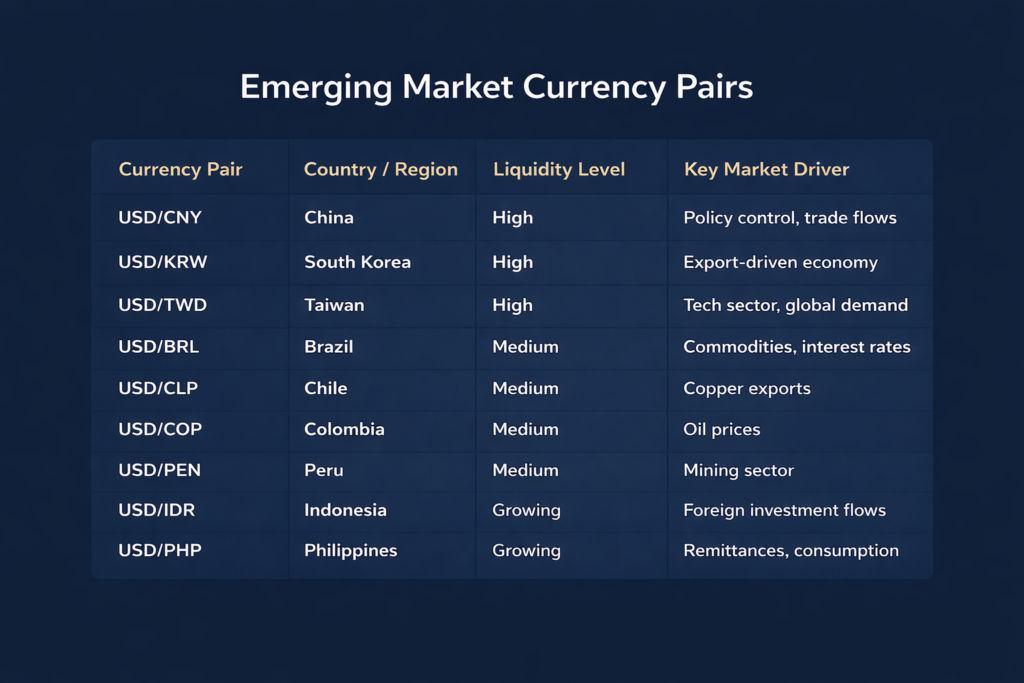
How to Read This List
All these currency pairs represent other macro drivers:
- Export and central bank policies dominate Asian currencies.
- The Latin American currencies are prone to commodity cycles.
- The level of liquidity shows the activity of these pairs in the offshore markets.
What Makes These Pairs Important in 2026
- Liquidity is high, which enables easier entry and exit of traders.
- Powerful macro drivers generate predictable trading.
- Growing institutional involvement is enhancing efficiency in pricing.
Top NDF Currencies to Watch in 2026
With the trend of global capital moving towards the emerging markets, some NDF currency pairs will be the most active in 2026. These currencies are unique because they are liquid, have macroeconomic significance, and are sensitive to the global market trends.
USD/CNY – Policy-Driven Stability with Controlled Volatility
Chinese yuan is also among the most actively traded NDF currencies. It is highly dependent on the central bank policies, trade balances and geopolitical developments in its movement. USD/CNY will be stable in 2026 but responsive to changes in policy, and as such, it will be a major pair to macro-oriented traders.
USD/KRW – High Liquidity with Export Sensitivity
The South Korean won is strongly linked to the export demand in the world, especially in technology and manufacturing. This renders USD/KRW very sensitive to the world economic cycles. It has a high liquidity in offshore markets, making it a favourite NDF pair among institutional participants.
USD/BRL – Commodity Exposure with Higher Volatility
The Brazilian real is affected by the price of commodities and domestic interest rates. It is more likely to exhibit volatility as compared to the Asian currencies, and this can present both risk and opportunity in the NDF trading strategies.
Why These Currencies Stand Out
- Good liquidity means effective execution.
- It is predictable when there are clear macro drivers for analysis.
- Market depth is enhanced by high institutional participation.
Emerging Market NDF Trends for 2026
The currencies of emerging markets will continue to be the focus of NDF in 2026 due to the changing macroeconomic environment and international capital flows. These currencies will not move in the same direction, but will tend to have region-specific patterns depending on the economic structure and externalities.
Asia: Policy Influence and Export Sensitivity
The central bank policies and the world trade demand have a significant impact on Asian NDF currencies like USD/CNY, USD/KRW, and USD/TWD. Being export-driven economies, their performance is highly connected to the manufacturing cycles, technology demand and currency management strategies.
The theme of controlled currency movements and policy intervention will likely continue to dominate the region in 2026, establishing comparatively fixed but dynamic conditions of trading.
Latin America: Commodity Cycles and Volatility
Commodity markets are closely associated with such currencies as USD/BRL, USD/CLP, USD/COP, and USD/PEN. Changes in oil, metals and agricultural prices may cause stiffer movements than Asian currencies.
This increases the volatility of Latin American NDF pairs, as well as appealing to any trader seeking an opportunity to obtain directional benefits on the basis of global commodity trends.
Key Trends Shaping NDF Markets in 2026
- Interest Rate Differentials: Currency movements are being caused by divergent monetary policies between the developed and emerging economies.
- Inflation Pressures: The high inflation in certain areas is raising currency volatility.
- Capital Flows: The inflow of foreign investment in emerging markets is still affecting the demand for NDF contracts.
- Geopolitical Risk: Geopolitical tensions and instability in the region are posing uncertainty to currency projections.
Institutional Outlook
The global views cited by organisations such as the International Monetary Fund indicate that emerging markets will keep on contributing more to global growth, and hence the NDF markets will become even more relevant to hedging and speculative strategies.
NDF Currency Forecast for 2026: What Analysts Expect
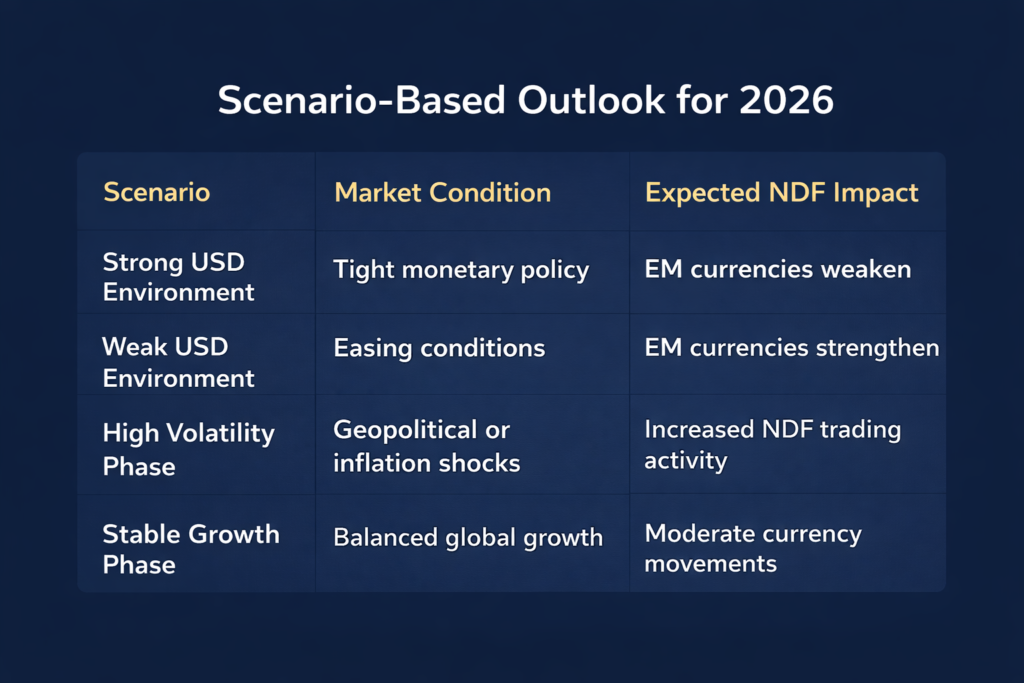
The future of NDF currencies in 2026 is likely to be influenced by the world monetary policy, the US dollar trend, and the inflow of capital into the emerging markets. Instead of one trend, analysts expect a heterogeneous environment in which various currencies react to various macroeconomic variables.
US Dollar Direction Will Play a Key Role
The US dollar strength is expected to continue being the main cause of NDF currency movements:
- An appreciation of the US dollar can exert pressure on the emerging market currencies.
- A depreciated dollar may favour inflows of capital and increase the value of NDF.
Interest Rate Differentials and Capital Flows
The difference in interest rates between the developed and emerging economies is likely to affect the performance of the currencies. Increased production in some areas can lead to foreign investment, and the decreased risk appetite can be caused by tightening of global liquidity.
The effects of these dynamics are a direct influence on forward pricing and volatility on NDF markets.
Scenario-Based Outlook for 2026
Institutional Perspective
Experience of leading institutions like Goldman Sachs and JPMorgan Chase indicates that NDF markets are gaining more and more significance in dealing with exposure to emerging economies.
These companies point out the liquidity situation, policy orientation, and global risk sentiment as some of the factors that are likely to affect the performance of NDF currency in 2026.
What This Means for Traders
- NDF markets will be very sensitive to macroeconomic changes.
- Opportunities will not be the same in all regions but will be based on a single trend.
- Positioning will be necessary through active monitoring of world indicators.
How to Invest in NDF Currencies in 2026
The non-deliverable forward (NDF) currencies are to be invested in a step-by-step manner as these contracts are traded in offshore markets.
Step 1: Selecting the Appropriate Currency Pair
Increased liquidity guarantees improved pricing and execution. Pay attention to such liquid pairs as USD/CNY, USD/KRW or USD/BRL.
Step 2: Learn to read the Market Drivers
The macro factors that affect every currency are the interest rates, exports, and commodity cycles. A clear understanding is used to evade random trades.
Step 3: Access the NDF Market
NDFs are bought and sold by banks and brokers who sell OTC derivatives. The terms and cost may be different, and the choice of the platform is important.
Step 4: Track Forward Pricing
In comparison to spot forex, NDF pricing is pegged on future anticipations. It is necessary to monitor forward rates and volatility.
Step 5: Engagement of Alternative Exposure
In case of restricted access, traders may consider new market currency funds or strategies that indicate the same trends.
Strategic Approach Matters
NDF markets need discipline and a well-defined structure. When traders utilise macro knowledge with risk management, they will be more consistent.
To individuals who want to venture into these markets with a systematic orientation, engaging the services of a specialised trading firm may offer a more enlightened and uniform way of doing so.
Risks in NDF Trading
Although NDF markets provide entry to the emerging currencies, they are also associated with certain risks that traders must be aware of before engaging in them.
Counterparty Risk
NDF contracts are over-the-counter (OTC) traded, which implies that there is no centralised exchange. This exposes the counterparty to the risk of the reliability of the trade.
Market Volatility
The currencies of emerging markets are subject to sudden changes in price because of fluctuations in interest rates, inflation or geopolitical events. This may result in increased uncertainty over major forex pairs.
Limited Transparency
NDFs are not traded as exchange-traded so pricing and liquidity may differ depending on the provider. That is why it is significant to use reliable sources and data.
Regulatory and Policy Risk
The movement of the currency can be directly affected by government policies, capital controls or central bank actions and in most cases with little notice.
Risk Management is Necessary.
Risk management is a disciplined approach that is required in order to succeed in NDF markets. The key to navigating these markets is position sizing, adequate analysis, and not being overexposed.
Where to Track NDF Currency Data in Real Time
The trading or analysis of NDF currencies requires access to reliable data. These markets are over-the-counter, so traders use specialised platforms to have a price and forward rate and macro insight.
Key Data Sources for NDF Markets
Institutional data platforms
The major NDF pairs available under professional platforms offer real-time forward rates, liquidity data, and market depth.
Financial news and analysis tools
These aid in monitoring macroeconomic changes, central bank actions, as well as global issues that affect currency flows.
Broker-provided dashboards
Most brokers provide combined applications that show forward pricing, charts and volatility of NDF currencies.
What to Look for in a Data Platform
- Live forward prices and quotations.
- Credible pricing among the key NDF pairs.
- Availability of macroeconomic variables.
- Simple and uncomplicated interface.
Why Data Accuracy Matters
In NDF trading, the decisions are made on the basis of expectations and forward pricing as opposed to the current spot rates. Availability of correct and timely information enables traders to react well to any changes in the market and prevent mispricing risks.
Final Thoughts
In the coming 2026, non-deliverable forward markets will take a bigger role in the trading of currencies across the world. As more people show interest in the emerging economies, NDF currencies provide a viable means of exposure as it avoids market limitations.
These opportunities are, however, complex. Macroeconomic forces like interest rates, capital flows and policy choices influence market movements, and therefore, it is necessary that it be structured and executed with discipline.
To traders who enter NDF markets with the appropriate framework, there is a high possibility of finding stable opportunities in various regions and currency pairs.
To individuals who want to move past the simple knowledge and develop a more organised approach to currency trading, Beirman Capital offers the opportunity to access market knowledge, strategic advice, and a rigorous structure that will help navigate the complicated markets, such as NDFs, with clarity and confidence.
FAQ
An NDF transaction includes settling the difference between two currencies at a forward rate, such as USD/CNY and agreeing on the rate at the maturity of the transaction, but not the currency itself.
NDF is an abbreviation that means Non-Deliverable Forward; this is a kind of foreign exchange contract where the gains or losses are settled in cash rather than by the exchange of the underlying currency.
Risks associated with NDF trading include default of the counterparties, extreme volatility in the emerging markets currencies, lack of transparency, and unexpected changes in the policy that will affect the pricing and liquidity situations.
No, an NDF is not a future. It is an over-the-counter forward contract and futures are standardised, exchange-traded and centrally cleared instruments that are settled on a daily basis.
The NDF pricing is determined by the interest rate differences, anticipated future spot rates and market demand and is based on the forward expectation as opposed to the current movements of the spot prices in the currency.
The most common NDF currencies are Chinese yuan, South Korean won, Taiwan dollar, Brazilian real, Chilean peso, Colombian peso, Indonesian rupiah and Philippine peso.
Get Complete Forex Trading Assistance