
What Is a Stop Loss Order? Best Stop Loss Strategies Traders Should Use in 2026
Learn what a stop loss order is, how stop loss vs stop limit works, and the best stop loss strategies traders use in 2026. Protect capital with structured risk management techniques.
Table of Contents
Trading online is simpler than ever before, and profitability is challenging. Regulated brokers are required to disclose their public risks, and these disclosures always indicate that approximately 70 to 89% of retail trading accounts incur losses. It is not the wrong market direction that is the main cause. It is poor risk management.
Most traders take hours to get the right entry and overlook one important question:
What will happen in case the trade fails?
Risk is defined by a well-placed stop loss order before the trade. It secures capital, eliminates emotional decision-making and establishes systematic implementation.
Survival is not a choice in the contemporary markets. It is the basis of long-term profitability.
What Is a Stop Loss Order in Trading?
A stop loss order is an automatic order that closes a trade when the price hits a predetermined loss level.
It enables traders to determine the maximum acceptable loss at which they can enter a position.
Simple Example
- Entry: $100
- Stop loss: $95
- Maximum specified risk: 5 dollars per share.
At $95, the position is automatically closed.
A stop loss does not kill losses.
It does not allow losses to get out of control.
Stop placement is not a last-minute decision by professional traders, but rather a trade planning decision.
Stop Loss vs Stop Limit Order
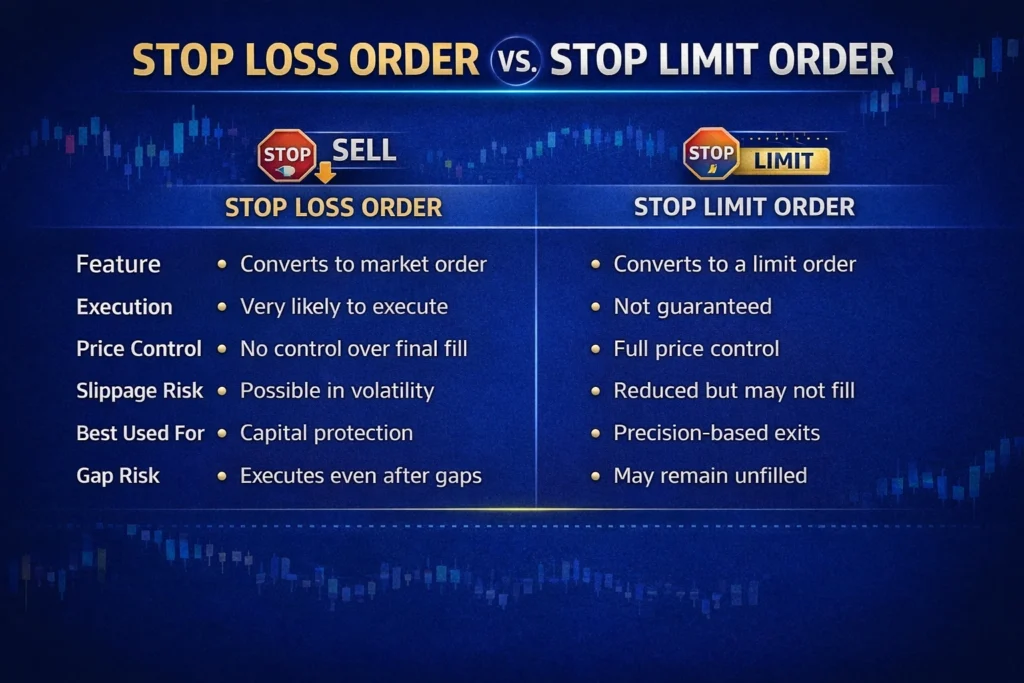
If immediate exit is a priority, a stop loss is preferred.
If price precision matters more than certainty, a stop limit is used.
Why Most Traders Get Stopped Out Too Early
The reason most traders are stopped out too soon.
It is not unusual to be stopped out.
Repeatedly being stopped out is normally a placement issue.
1. Obvious Level Placement
Most traders have their stop loss at visible support, resistance or round numbers.
These regions frequently receive liquidity sweeps, and then the price moves back to the original direction.
2. Stops That Are Too Tight
Markets are volatile in nature.
Normal volatility can easily cause very tight stops to be hit, rather than a failed trade idea.
3. Ignoring Volatility
The same distance from the stop in every market situation is risky.
Unstable assets should have broader stops than stable ones.
4. Emotional Adjustments
Post-entry stop loss is a violation of risk discipline.
An increase in stops increases the size of losses.
Premature tightening eliminates the chances of winning.

Best Stop Loss Strategies Traders Use in 2026
No standardised stop loss technique exists.
The right approach will be based on the market structure, volatility, and trading style.
The following are the best models that are applied in contemporary trading.
1. Percentage-Based Stop Loss
Risk is determined as a constant percentage of the entry price or account size.
Example:
- Entry: $100
- Risk: 2%
- Stop loss: $98
Best for:
- Beginners
- Strict capital management
- Structured risk systems
Limitation:
Lacks volatility or chart structure.
2. Key Level and Structure-Based Stop Loss
Stop loss is set outside technical levels, including:
- Support and resistance
- Trendlines
- Pivot points
- Fibonacci retracement areas.
When the level is broken by price, the trade idea is invalid.
Best for:
- Technical traders
- Swing traders
- Trend-based setups
This matches risk to reality in the market structure.
3. ATR-Based Stop Loss
The Average True Range is used to measure normal price movement.
Volatility is used to compute stop loss:
Stop Distance = Multiplier × ATR.
Common multipliers:
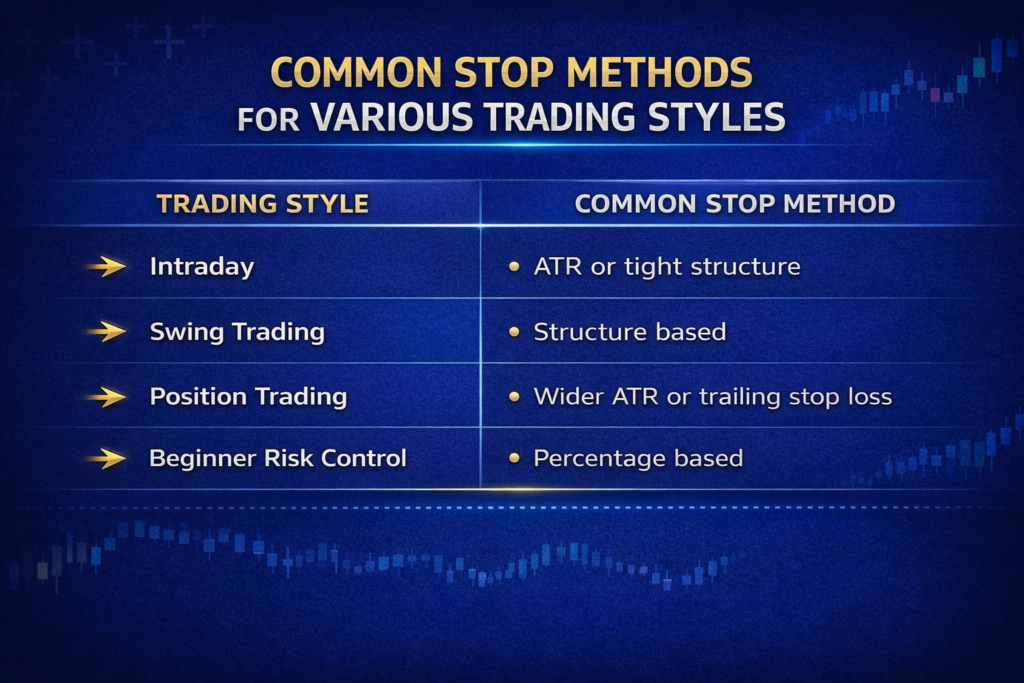
- 1.5 to 2 for intraday
- 2 to 3 for swing trades
- 3 to 4 for position trades
Best for:
- Forex
- Crypto
- High volatility markets
This approach minimises premature stop-outs due to normal market noise.
4. Trailing Stop Loss
A trailing stop loss follows the direction of profit as the price increases.
It captures profits and keeps the downside covered.
Best for:
- Strong trends
- Momentum strategies
- Position trades
Weaker in turbulent markets.
How Professional Traders Choose the Right Stop Loss Method
Seasoned traders do not just choose a stop loss strategy.
They align with the stop approach to the market environment, trade organisation, and risk tolerance.
It is a rational rather than an emotional decision.
Step 1: Define Trade Invalidation
Professionals inquire before getting into a trade:
What is the price at which this trade idea is wrong?
That is the natural place where the stop loss order will be.
When the price gets to that level, the initial arrangement ceases to be true.
Step 2: Assess Market Volatility
Stop distance is dependent on volatility.
- Tighter stops are possible in low-volatility markets.
- Wider stops are needed in high-volatility markets.
- News-driven sessions require an additional buffer.
Many traders use ATR-based or structure-based stops in volatile environments as opposed to fixed percentage models.
Step 3: Align With Trading Style
Different timeframes require different approaches.
Step 4: Calculate Position Size After Stop Placement
The professional performance is as follows:
- Identify entry
- Define stop loss
- Adjust the position size to the risk percentage.
Not the other way around.
This guarantees uniform capital protection among trades.
Core Principle
The most appropriate stop loss technique is not the one that makes one feel safe.
It is the one that makes logical sense to the trade setup and market environment.
Consistency is enhanced when the location of stops is not emotional.
How to Set Stop Loss and Take Profit on Trading Platforms
The majority of trading platforms enable traders to add a stop loss order and take profit level when placing an order. Nevertheless, the platform itself is not the true advantage. It is a result of systematic risk planning.
Professional trading systems focus on a set-off execution order:
- Identify entry
- Define invalidation level
- Place a stop loss
- Calculate position size
- Set take profit
This sequence will make sure that the risk is managed before exposure.
Stop Loss vs Stop Limit in Trading
In making a trade, traders usually have a choice between:
- Stop Loss: Switches to a market order when it is triggered, and exit certainty is the primary consideration.
- Stop Limit: Will only execute at a given price, where the precision of the price is of high priority.
Capital protection is typically more important in volatile markets than a perfect fill price.
Structured Risk Approach
A typical error is the determination of stop loss once position size has been determined.
The logic of professional risk management models is the opposite.
Trading systems such as those highlighted by Beirman Capital educate traders to determine position size after determining stop distance. This helps to avoid excessive losses and makes risk per trade the same.
The order is executed through the platform.
The capital is safeguarded by the strategy.
Stop Loss Insurance Mindset: Protecting Trading Capital
A stop loss is viewed by many traders as a weakness.
It is viewed by professionals as insurance.
Protection precedes any other financial decision. Property is insured by investors, assets by businesses, and exposure by institutions. The same should be applied to trading capital
A stop loss order is capital insurance. It determines the maximum loss that can be accepted before uncertainty sets in.
Why This Mindset Matters
Without predefined risk:
- Minor losses may become huge withdrawals.
- There is an increase in emotional decisions.
- A single trade will ruin months of work.
Structured stop placement:
- Per trade risk is kept in check
- Capital remains protected
- Consistency in the long term is made possible
Trading is not a matter of not making losses.
It is about surviving them.
The Capital Preservation Rule
There is a simple rule that professional traders have:
Protect capital first. Grow capital second.
This is the reason why stop loss placement is determined prior to position size, prior to leverage and prior to profit objectives.
Stop losses cease being frustrating when traders embrace the insurance mentality. They join a sustainable trading system.
Common Stop Loss Mistakes Traders Must Avoid
The stop loss order may be placed in the wrong way, and even the best strategy may fail.
Bad market analysis does not result in most of the trading losses. They are a result of bad risk implementation.
The following are the most frequent stop loss errors that continue to destroy trading accounts.
1. Placing Stops at Round Numbers
1. Placing Stops at Round Numbers
Most traders set stops at the apparent levels, like:
- 1.2000 in forex
- $100 in stocks
- Significant psychological price areas
Liquidity is usually drawn to these levels. These areas are often tested by markets prior to the continuation of the move.
Outcome: Traders are stopped out prior to the development of the trade.
2. Moving the Stop Loss After Entry
Expanding a stop loss when the price is against the position is one of the most dangerous habits.
This adds risk to the initial plan and eliminates uniformity.
The stop loss must be changed based on organised reasons and not emotional uneasiness.
3. Setting the Same Stop Distance on Every Trade
Various assets do not move at the same rate.
Using a fixed stop distance without volatility in mind will make one more likely to be stop lossed in normal price movements.
Volatility-based techniques like ATR models can be used to avoid this error.
4. Ignoring Risk-to-Reward Ratio
Other traders are interested in stop distance but do not compute the possible reward.
In case the risk is $100 and the realistic reward is $80, the trade does not have a mathematical advantage.
The position of stops must be in favour of a desirable risk-to-reward structure.
5. Trading Without a Predefined Exit Plan
There is no strategy to enter a trade without a predefined stop loss.
It is hope.
Professional trading systems, such as structured risk models as described by Beirman Capital, insist that all trades should have an invalidation point that is established before the trade.
In serious trading, capital protection is not a choice.
Key Reminder
There is no stop loss to prevent losses.
It is there to ensure that a single error does not turn out to be disastrous.
Minor controlled losses can be handled.
Losses that are not controlled terminate trading careers.
Conclusion
Losses are part of trading. Big uncontrolled losses need not be.
Risk is defined by a well-placed stop loss order prior to the start of the trade. It safeguards capital, minimises emotional decision-making and provides uniformity. Those traders who do not pay attention to the stop placement usually have unstable outcomes, not because their analysis is incorrect, but because their risk management is poor.
It does not matter whether you are using a percentage-based model, structure-based placement, ATR calculation, or a trailing stop loss; the goal is the same: to limit the downside exposure and leave the upside potential.
Capital preservation is the basis of sustainable trading. Performance can be measured and repeated when the decisions to stop losses are made in advance, and the size of the position is changed accordingly.
Organised risk management strategies, such as those that Beirman Capital focuses on, point out that the long-term success is achieved through disciplined execution.
Survival is the first thing in trading. Growth follows.
FAQ
Take profit and Stop loss is a trade exit levels that traders set to lock the profit and limit the losses.
Losing is a part of trading and one cannot avoid losses. However one can minimize the losses by using risk and money management strategies.
Stop Loss is a market order to buy or sell financial assets. Under this, traders set a limit to close a position when the price moves against their prediction.
Suppose a trader has bought a EUR/USD pair at 1.1150 and set the stop loss limit at 1.1145. In this case, if the prediction went wrong, the price fell to 1.1140 the trader would not lose a big amount as the trade was automatically closed when the price reached the stop loss level of 1.1145.
Using a risk-to-reward ratio of 1:3 to set stop-loss levels is the best stop-loss strategy.
When trading in risky assets such as forex, stocks, crypto, indices or others, a trader should use stop loss and take profit orders.
Get Complete Forex Trading Assistance






Pingback: How to trade commodities